

Overview
In May 2025 a small group of volunteer divers from around the United Kingdom were brought together to survey and record Fireworks Anemones in Loch Alsh and Loch Duich, spectacular sea lochs in the Scottish Highlands.
The aims of the event were to:
- photograph and measure marked anemones at a Project Baseline monitoring site in Loch Alsh
- investigate less accessible areas around the Loch Alsh monitoring site with Diver Propulsion Vehicles
- repeat some transects that had been surveyed in Loch Duich and Loch Beag by the Seasearch recording scheme in 2011
- carry out some preliminary boat dives to survey locations that had previously been identified as potential Fireworks Anemone sites
Biodiversity in sea lochs
Sea lochs are an iconic feature of Scotland and contain a host of remarkable marine life specially adapted to the conditions. Consequently, some parts of the west of Scotland have been designated as Marine Protected Areas. The Lochs Duich, Long and Alsh Marine Protected Area lies between the high mountains of Skye and Kintail and is home to two particular species of note, Gaping File Shells (or Flame Shells) and Fireworks Anemones.
Fireworks Anemones
The Fireworks Anemone (Pachyceriathus multiplicatus) is one the largest anemones found around the United Kingdom and is popular with underwater photographers. They are about the size of a dinner plate and with a crown of up to two hundred tentacles, they are an impressive sight on a murky seabed. Although it is not unusual to find them in sea lochs, the Scottish population has been estimated at 95% of the entire number recorded internationally.
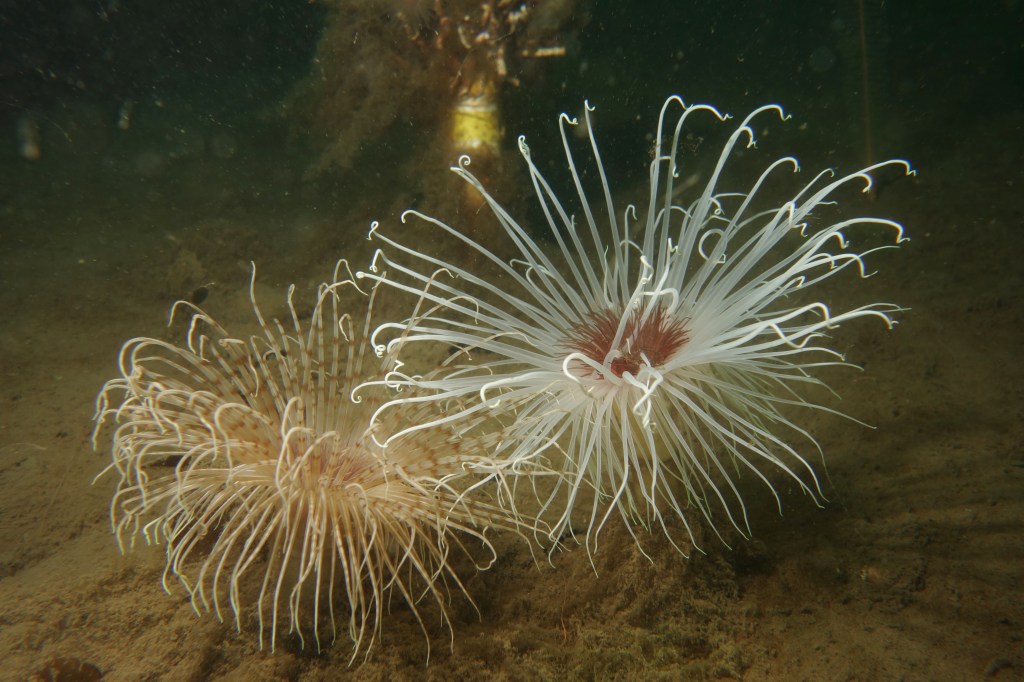
Anemones fall into a group of marine animals with stinging cells that includes jellyfish and corals, and there are many kinds. Although a large proportion live attached to rocks or hard surfaces, the Fireworks Anemone prefers soft sediments and is one of a few that create a tube to live in. At up to a meter in length, this acts as safe place for the anemone to retreat into. They are most at home in locations that are sheltered from wave energy and currents. Although they are technically a solitary species, they can occasionally live in beds of hundreds of individuals, such as those located in Loch Alsh and Loch Duich.
Fireworks Anemones have not been well researched. Their most notable feature is their very long, elegant tentacles which they hold up in the water column in order to passively catch a meal. These are sticky, with weak stinging cells which they use to immobilise zooplankton. They have been occasionally kept in aquariums (where they are fed on ground brine shrimps) but their longevity remains unclear. The most likely way they reproduce is by dispersal of larvae, and it is suggested that these stay close to the seabed and do not move far from the parent anemone.
Monitoring in Loch Alsh
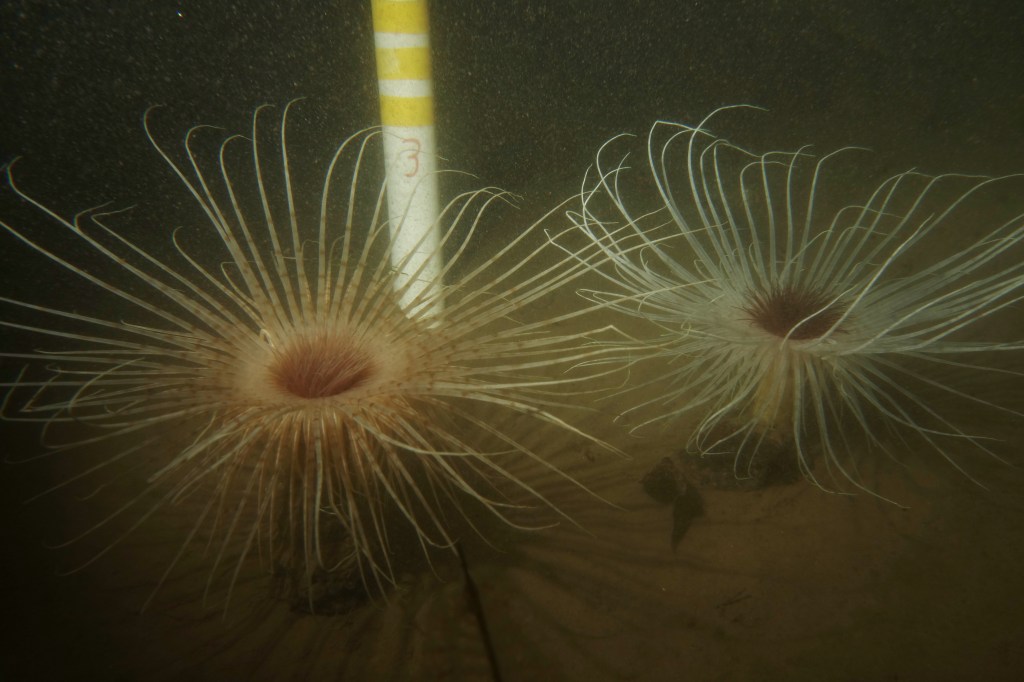
Project Baseline Loch Alsh was set up in 2019 to monitor a previously undocumented Fireworks Anemone bed at Ardelve, close to Eilean Donan Castle. The monitoring site is in an area approximately twenty-five metres square, at the edge of a dense bed that contains several hundred Fireworks Anemones. There is a conveniently positioned 9m long metal wreck at the east side of the site and temporary catch line runs from this to enable divers to locate the survey stations.

Six anemones at the site are currently being monitored at between 16-18m depth, and the survey stations are marked with short plastic pipes that have been pushed into the seabed. To date, thirty-five monitoring surveys have been recorded since the start of the project in 2019 and a large number of comparable photographs are currently available on the Project Baseline website database.
Contributing to Seasearch
The Project Baseline monitoring programme runs in tandem with recording for the popular UK citizen science scheme, Seasearch. Project Baseline divers have contributed twenty records in and around the monitoring site since 2017. The data collected by Seasearch is easy to access online and this enables divers to either seek out new survey sites, or purposely target previously surveyed locations. For instance, a brief check of the map on their website reveals that fifty Seasearch surveys have recorded Fireworks Anemones in the MPA.
Although most of the information that Seasearch gathers is from one-off surveys, it has also done a range of research work focussed on specific species and there are several published reports describing Fireworks Anemone surveys in Scottish sea lochs between 2005 and 2013.
The 2025 Project Weekend
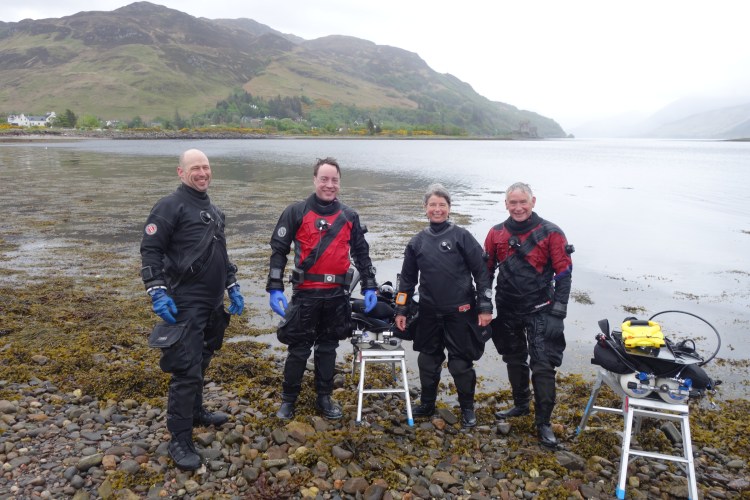
The survey work in May was structured around four days diving, based at accommodation on the Isle of Skye. It was a great benefit that the facilities included a compressor and that nitrox was available. Seven divers were signed up for the long weekend and everyone was able to contribute their skills not just under the water, but also on the shore and boat.
Dives at the Monitoring Site
The first day involved five volunteers diving at the Loch Alsh monitoring site. This has been visited regularly since 2019 and the dives followed the normal procedure of photographing the anemones, measuring them, and recording temperature and visibility (a new secchi disc was installed to replace the previous one). In addition, the species that were seen were recorded for Seasearch.
Five of the six anemones were visibly in ‘feeding mode’, with their tentacles out of their tubes. However, their measurements suggested that they were not fully stretched out. It was very noticeable that there was a large amount of stringy brown algae, both draped over items on the seabed and in the water column and there was speculation as to whether this had any effect on the anemones. One small anemone that had been suspected of being eaten by something was still not visible; whereas another small anemone, that had previously had damaged tentacles, had regrown them.
The semi-enclosed basin where the monitoring site is located is around half a kilometre across, which has meant that previously only a small part of it could be surveyed from the shore. With this in mind, two divers with DPVs headed out to explore the west part of the basin. Although it had not been possible to use a GPS on this occasion, the overall impression was that the Fireworks Anemones petered out, and beyond the sill of the basin there was a transition to a rockier habitat with brittle star beds (normally an indication of greater tidal currents).
Transects in Loch Duich
It had been over ten years since the previous Fireworks Anemone surveys by Seasearch at this location so it seemed like a good time to return to some of the transect sites. Two locations were selected at the head of Loch Duich: School Bay near Inverinate and in Loch Beag, a small subsidiary of Loch Duich that has historically had an extensive anemone bed.
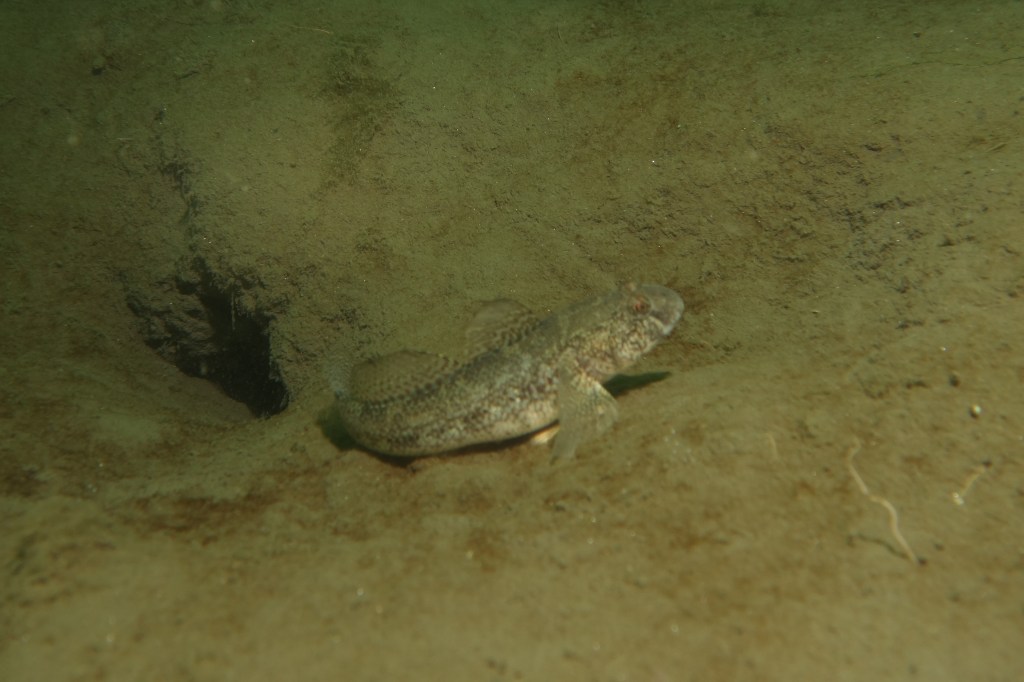
The 2011 surveys had recorded the number of anemones seen on a transect, each individual’s size, the speed of their tentacle retraction, and other associated species. For the 2025 surveys the divers concentrated solely on counting the anemones and giving an overall impression of the range of sizes in the group counted. The slight change in methodology meant that many more anemones were counted and recorded along the transects, giving a greater sense of their abundance, which in Loch Beag ran into the hundreds. However, this was at the expense of a more detailed examination of each individual anemone and the surrounding species. To compensate for this on one transect in School Bay, where no anemones were seen, there was time to record other species and this information was used to complete a Seasearch survey form.
Boat dives in Loch Alsh
The final day of project diving involved launching a RHIB and taking it along Loch Alsh to investigate some new potential Fireworks Anemone sites. Two bays on the north side of the Loch were selected for exploration and, as with the DPV diving, this was very much a recce in order to get a first impression. Even so, the transect methodology was still used in order to be able to repeat the dives on a future occasion
The first location was Mill Bay, near Kirkton, which showed as promisingly muddy seabed on the chart. Over forty Fireworks anemones were counted on one of the dives and there appeared to be very large numbers of small anemones (less than 10cm). Further surveys at this site should help to determine if these are a newly established Fireworks Anemone bed, or the more common species of Burrowing Anemone. The second site, in Nostie Bay, had a more mixed, gravelly seabed and no Fireworks Anemones were spotted during the dive.
Weekend outcomes
Fireworks Anemones were noted in Loch Duich back in the 1980s, and there are beds that still appear to be healthy after several decades. This is in no small part down to the ban on dredging and trawling in the MPA, with only a limited amount of creel fishing. The long-term monitoring site has started to give a sense of the behaviour of the anemones and how they appear over the different seasons. However, the amount of algae seen at the monitoring site over the weekend was a little concerning. Longer term monitoring will help to show if this is a predictable or occasional event. Seasearch survey forms were submitted for the Ardelve monitoring site, School Bay in Loch Duich, and Nostie bay in Loch Alsh.
The results of the transect dives gave a sense of how the anemone beds in the lochs have fared since the previous Seasearch surveys in 2011. Fortunately, they are still in high abundance, particularly in Loch Beag. It was great to be able to explore up towards the Skye Bridge with the RHIB and find significant numbers of anemones in one of the other bays. More DPV and boat dives around the lochs in the future could improve our knowledge of where the greatest densities of the anemones are located.
Collaborative Project Diving
The Project Baseline Fireworks Anemone weekend is a good example of how relatively small scale diving events can still generate significant and meaningful data, as well as being a lot of fun. A great deal can be achieved with around half a dozen divers who are willing to be flexible in their roles. In this case there were huge benefits from having such a tight-knit team. Each event like this invites future exploration and research, which is open to anyone who has the skills and enthusiasm for this kind of diving.
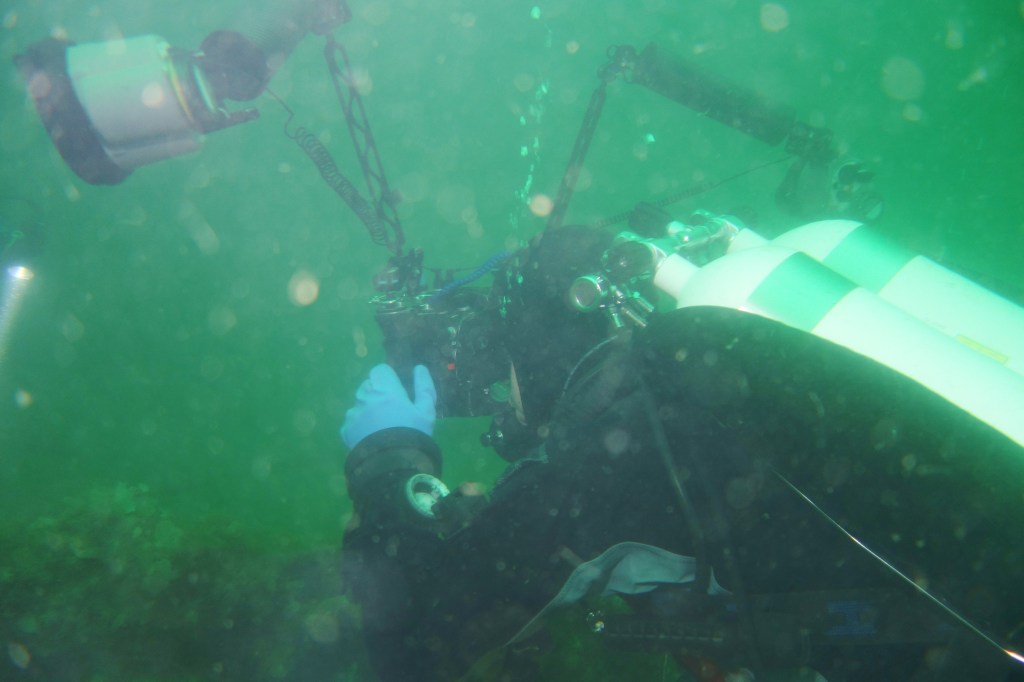
Project Baseline Loch Alsh is grateful for the assistance of a number of people who helped to make the weekend a success. Many thanks to the volunteer divers who carried out the surveys: Anne Buchan, Jillian Hunter, Martin Maple (Trustee, Project Baseline UK), David Price, Joe Taylor
Thanks also to those who provided information and advice: Owen Paisley (Seasearch Scotland), Marcus Rose (Chair, Project Baseline UK), Chris Rickard.
Special thanks to Anne Buchan and Jim Williamson who provided the RHIB on the third day of diving and enabled us to visit the sites in Loch Alsh; and to Hilary Mackay for providing boat support.
Author: Vanessa Charles, who has managed the Fireworks Anemone Monitoring Project in Loch Alsh since 2019.
 Project Baseline UK