

Overview
In September 2023 the Wild Oysters Project created an oyster reef off the coast of Seaburn. The project placed over 750 tonnes of cultch (a mix of limestone gravel and weathered scallop shell) on the seabed over an area of 7,500 square meters. At the centre of the cultch 10,000 mature native oysters were added in an attempt to restore this once prevalent habitat.
However, in October 2023 Storm Babet hit the area, which was a 1 in 10-year strength storm generating 7-8 meter waves. The storm was found to have displaced the cultch and native oysters, but ROV operations could not determine where the majority of the dropped material had been moved too.
Project Baseline teamed up with Groundworks NE & Cumbria in June 2024 in an attempt to locate, map, and determine the health of the native oysters.
The Surveys
Based on the direction of the prevailing winds during the storm, and following drop camera surveys, 6 locations were targeted for diver surveys. A shot line was dropped at each of the points in the diagram below and divers used a tape measure to complete surveys out to 50m from the centre point. Where oysters or cultch were found the divers completed video surveys and noted the compass heading and distance from the centre point. A small number of live oysters were taken to the surface for inspection by the marine ecologist supporting the project. All live oysters were subsequently returned to the sea on completion.
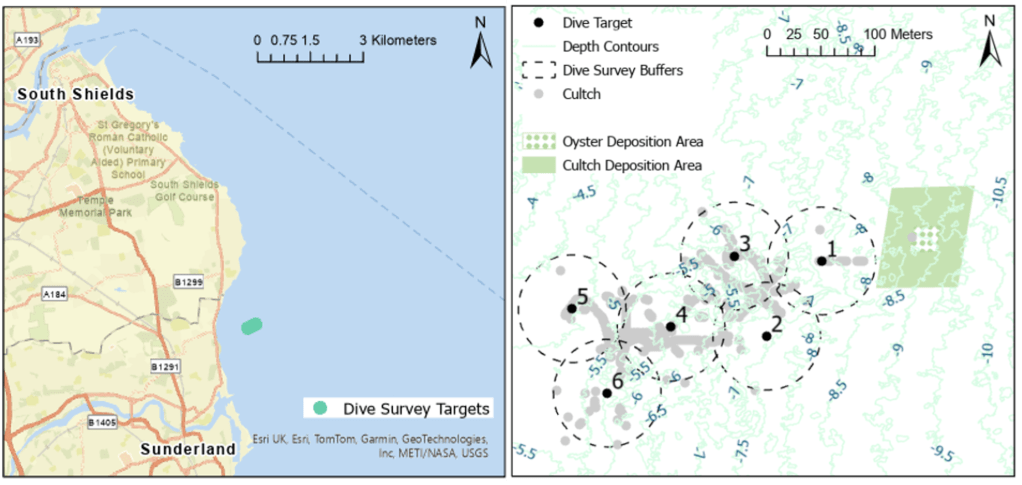
Project Overview
This collaboration between Groundworks and Project Baseline was over a year in the making. Following several video calls to discuss project aims, arrange logistics, and ensure the dive team came equipped for the project dives, the teams finally got to deploy to the NE of England to get started. Five divers supported the surveys each day, allowing each site to be surveyed by 2 teams to speed up the process.

Whilst the dive teams did discover live oysters, the numbers were relatively low. Only 11 oysters were discovered during the course of the project, with 5 of these still alive. The live oysters appeared to be in good condition and cultch was discovered on all of the dives, with the quantity varying at each site.

Despite the slightly disappointing number of live oysters found the data collected has been invaluable to Groundworks. It has allowed them to baseline the remaining cultch and oyster levels in the area, which will inform follow on efforts.
For the divers the project was a great opportunity to build experience and to work with scientists undertaking this important habitat restoration work. As ever all of the divers participating in the project were volunteers. The project was a great example of citizen science at work, demonstrating that highly trained, capable volunteer divers can be extremely effective when working alongside scientific and conservation groups.
The Importance of Native Oysters
Native oysters in the UK have been in decline over recent years owing to over fishing, habitat destruction, pollution and disease. Given their importance as ecosystem engineers many efforts are underway around the UK to restore them. The oysters create a very distinct habitat, where the shell deposits allow other species to colonise. Oysters are extremely effective at filtering the surrounding sea water, removing organic matter from the water. The shells constructed by oysters also act as an effective carbon sink. As a result native oysters were listed as Priority Species in the UK in 2010.
[Ref: Gewin, V. (2021) ‘“For a brown invertebrate”: rescuing native UK oysters’, Nature (London), 600(7887), pp. 182–182. Available at: https://doi.org/10.1038/d41586-021-03573-5.%5D
 Project Baseline UK